
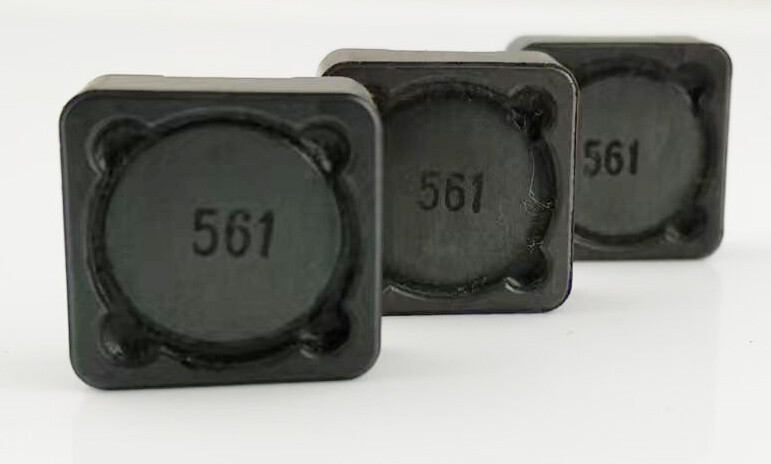
When selecting an inductor for portable power applications, the three most important considerations are: size, size, and size. The circuit board area in mobile phones is extremely limited and precious, especially as various functions such as MP3 players, television, and video are added to the phone. Increased functionality also increases battery current consumption. Therefore, modules previously powered by linear regulators or directly connected to the battery require more efficient solutions. The first step in achieving a more efficient solution is to use a magnetic buck converter. As the name suggests, this requires an inductor:
Besides size, the main specifications of an inductor include inductance value at the switching frequency, DC resistance (DCR), rated saturation current, rated RMS current, AC impedance (ESR), and Q factor. Depending on the application, the choice of inductor type—shielded or unshielded—is also important. Similar to DC bias in capacitors, a 2.2uH inductor from manufacturer A may be completely different from one from manufacturer B. The relationship between inductance value and DC current over the relevant temperature range is a very important curve and must be obtained from the manufacturer. The rated saturation current (ISAT) can be found on this curve. ISAT is generally defined as the DC current at which the inductance value drops to 30% of its nominal value. Some inductor manufacturers do not specify ISAT. They may only provide the DC current at a temperature 40°C above ambient temperature.
DCR causes conduction losses and affects efficiency at higher output currents. ESR increases with operating frequency and dominates switching losses at lower output currents. ESR is directly proportional to the Q factor. At the same frequency, inductors with lower ESR have a higher Q factor. Why should system designers consider ESR and Q factor when the inductor meets all other specifications? When the switching frequency exceeds 2MHz, special attention must be paid to the inductor's AC loss specifications. Inductors from different manufacturers with comparable ISAT and DCR listed in the specifications may have vastly different AC impedances at the switching frequency, leading to significant efficiency differences under light load conditions. This is crucial for improving battery life in portable power systems, as the system spends most of its time in sleep, standby, or low-power modes. Since inductor manufacturers rarely provide ESR and Q factor information, designers should proactively request this information from them. The inductance-current relationship provided by manufacturers is often only valid at 25°C, so relevant data within the operating temperature range should be requested. The worst-case scenario is typically 85°C.
Consider an example of a buck converter with the following specifications: FSW = 2MHz, VIN = 5.5V, L = 2.2 μH, VOUT = 1.5V, I = 0 to 600mA, ΔI = 289mA (calculated value). The 2.2μH rated inductor has a DCR of 0.2Ω at low frequency and an ESR of 10Ω at 2MHz. The DC and AC losses caused by the inductor can be calculated using the following formulas: DC loss = I² x DCR, AC loss = (ΔI²/12) x ESR. From these formulas, it can be seen that at higher output currents, low-frequency or DC losses dominate; at lower output currents, AC losses dominate. ΔI is the peak-to-peak ripple current of the converter, and its amplitude is the same at both high and low output currents in continuous conduction mode. Mathematical calculations show that when I = 600mA, 91% of the total inductor loss is DC loss; when I = 50mA, 93% of the total inductor loss is AC loss. Figures 4a (ESR) and 4b (Q) show inductors from manufacturer A (low ESR, high Q value) and manufacturer B (high ESR, low Q value), and also show the efficiency curves of a 2MHz converter using these inductors (Figure 4c). Based on this data, even though manufacturer A has a higher DCR, it can provide higher efficiency under light load conditions.
Depending on the application, shielded or unshielded inductors can be selected. Generally, shielded inductors are used in portable applications that must meet strict EMI specifications. Last but not least, there are two types of inductors based on their manufacturing method. The first type is the traditional wire-wound coil inductor, and the other is the newer chip inductor. Chip inductors are becoming increasingly popular due to their advantages in size and height. The installation speed during PCB assembly is also one of the advantages heavily promoted by chip (multilayer) inductor manufacturers.
When selecting a switching solution, system designers must consider certain key specifications of chip inductors. The relationship between inductance and DC current as a function of temperature is a major parameter where wire-wound inductors and chip inductors differ significantly. Figure 5 shows a schematic cross-section of a wire-wound coil inductor and a chip inductor. As seen in Figure 6, generally, the inductance-DC current and temperature relationship curve of wire-wound inductors is very flat before the saturation current. After the saturation current, there is a sharp drop with increasing current. Typically, ISAT is 10% to 20% lower at 85°C than at 25°C. At 25°C, chip inductors have an initial inductance value higher than the rated value.
Once the current increases, the chip inductance begins to decrease. Therefore, in most cases, the definition of rated ISAT is not applicable to chip inductors. The rated RMS current, which specifies the temperature rise, also determines the rated current of the chip inductor. The inductance value decreasing with temperature, not with DC current, is another characteristic of chip inductors. Regarding the actual inductance value, system designers must carefully select the correct inductor and find the minimum inductance value according to the specifications. Incorrect inductor selection can affect stability, cause sub-harmonic oscillations, and/or reduce the rated output current of the switch.
Similar to the case of ceramic capacitors, designers should focus primarily on the inductance value in actual operating conditions, rather than the rated inductance value. How to select the rated current of an inductor for a magnetic buck converter? The easiest method is to choose an ISAT rating greater than or equal to the maximum current limit of the switch if the inductor's rated IRMS is greater than the required output current. However, as we have seen with chip inductors, we must search for the minimum inductance value that satisfies the stability and output current requirements.
Choosing a higher value chip inductor (e.g., 3.3μH instead of 2.2μH) to meet the inductance requirements is not feasible, because for inductors of the same package size, the higher the inductance value, the more drastic the decrease. Furthermore, there are various differences among chip inductor manufacturers. For example, manufacturer A might use low-permeability materials, causing the inductance value to change gradually. However, this approach requires more dielectric layers. Therefore, compared to manufacturer B, which uses high-permeability materials and experiences a more drastic decrease in inductance, manufacturer A will have a higher DCR, while B will have a lower DCR.
Related Posts
Online Message
Thank you very much for writing to us. Please leave your message and contact information, we will reply to you within 24 hours.